DO the math, DON'T overpay. We make high quality, low-cost math resources a reality.

Showing posts with label art. Show all posts

Thursday, August 29, 2019

Four Mathematical Artists!

To quote Danica McKellar, "One of the most amazing things about mathematics is the people who do math aren't usually interested in application, because mathematics itself is truly a beautiful art form. It's structures and patterns, and that's what we love, and that's what we get off on." Mathematics and art have always been linked. Studying mathematics requires a creativity that resembles art, and artists often borrow concepts from mathematics in their art. Here are a few artists who have been inspired by mathematics in their works!

MC Escher
Image result for mc escher
Relativity by MC Escher (Source: Vogue Australia)

Escher was interested in several fields of mathematics, including both Euclidean and non-Euclidean geometry and topology. He explored several of these ideas in his pieces. Tessellations and Mobius strips are among his mathematical explorations. Although he never considered himself a mathematician, he was well-regarded by and mingled with mathematicians at the time, and even conducted research into tessellations!

Leonardo Da Vinci
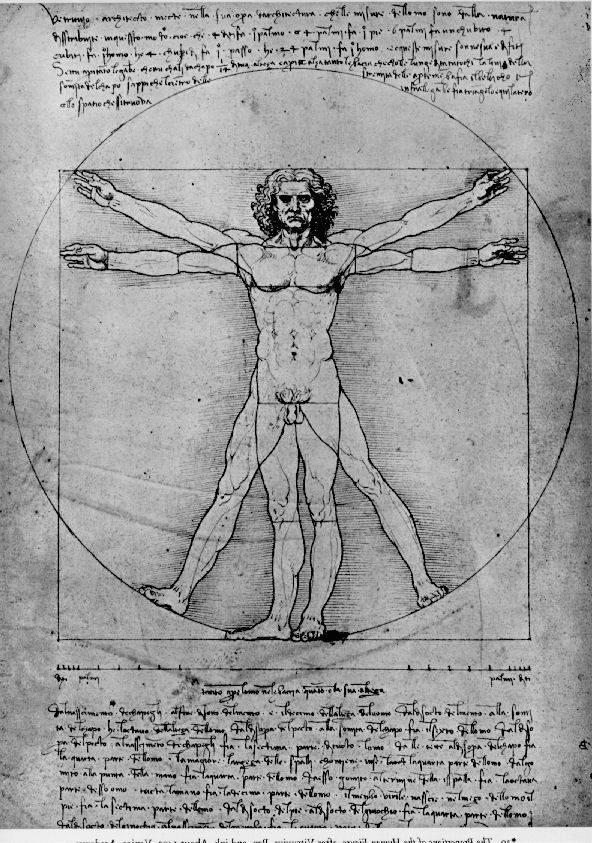
Image result for vitruvian man
Vitruvian Man by Leonardo Da Vinci (Source: WikiArt)

The original Renaissance Man, Da Vinci is most well known for the Mona Lisa. However, his interest in math and science appeared in his art and many of his sketches. The Vitruvian Man (pictured above) shows what Da Vinci believed to be the geometrically ideal man. Additionally, he used mathematical concepts such as the golden ratio and played with linear perspective in The Last Supper and the Mona Lisa!

The Writers of Futurama

From "The Prisoner of Benda" by Ken Keeler (Source: Buzzfeed)

We have talked about Futurama and math before on this blog and writing may not technically be art, but several of the writers of this cartoon were well versed in mathematics. Several of them, including the show's creator David X. Cohen, published papers in mathematics, and mathematical concepts have been presented on the show, including a theorem created for the show!

Ada Dietz
Image result for ada dietz

From Algebraic Expressions of Handwoven Textiles by Ada Dietz (Source: Flickr)

Dietz was a math teacher who decided to apply what she taught in her crafts! Her best known work is the monograph titled Algebraic Expressions of Handwoven Textiles, which is an instructional book showing how to incorporate algebra into woven crafts. To learn more about her methods and to see her designs check out this site !

Friday, January 27, 2017

Using Math to Create Something Beautiful

                   Think back to when you were first introduced to functions, thin lines depicting a single value output for each input in a domain.
A Function
For many people, the idea of what a function ‘looks’ like does not change much from this bland depiction of data. However, data can be crafted into something that carries much more information than just inputs and outputs, and in the right hands an enormous and messy set of data can be presented in a powerful way. Indeed, data representation is an important part of any scientific field.
            Compacting more data into inputs and outputs provides not only more information, but also a more stunning visualization of data. In a vector field, a single point can contain information about location, strength and direction of a force.  The more information a function tracks, the more stunning the display becomes, with 4 or even 5 dimensions represented on a graph of three-dimensional space and color.

Vectors depicting the strength and direction
of a magnetic field at discrete points.
A 3D graph, with a 4th color dimension
 Vector fields can even represent information that cannot be easily compiled into a simple function, which allows for out-of-the-ordinary occurrences in nature to be studied more carefully.
With developments in technologies that offer efficient data manipulation, the possibilities of what we can do with functions and data are more far-reaching than ever. Anne M. Burns of Long Island University Uses computers to create beautiful representations of functions.
Burns plots complex valued functions as a vector field, seen here.
The advantages of this technique transcend aesthetic purpose, and can be used to find roots of functions at a glance.
Attributing more dimensions to an occurrence is useful and can be beautiful, but what if the object or function in question is impossible to make sense of as it is? It is often handy to project or unfold an N-dimensional surface onto an (N-1)-dimensional surface. Most of the time, in calculus, a three-dimensional surface will be looked at as a two-dimensional projection on the xy, yz, or xz plane in order to set up an integral to find the volume of the object. In theoretical physics, this technique of reducing the dimension of mysterious happenings is used to speculate the nature of the universe. A common example, and perhaps the most accessible way to think of this process is the unfolding of a four-dimensional cube, the tesseract.
The nets of a 3D cube and a 4D hypercube above.
Dali's Corpus Hypercubus (1954)
This way of thinking about higher dimensions caught more than just the eyes of mathematicians and scientists. Salvador Dali, the great surrealist painter, was fascinated by the advances in science during the twentieth-century. In the 1950’s Dali was fascinated by nuclear physics and quantum mechanics, and found inspiration for many paintings in mathematics.

-->
At its core, mathematics does not only seek knowledge, but also pursues beauty in the natural world.


Works Cited
  • The Function graphic was found on the page of Maret School's BC calculus page, and is spliced with Charlie Brown of Peanuts, created by Charles M. Schulz.
  • The Magnetic field graphic was found on Vassar College's Wordpress blog, under a lecture by Prof. Magnes.
  • 4D graph curtesy of user Blue7 on math.stackexchange. 
  • Find all of Anne M. Burn's Work here.
  • The Cube net image was found here

Any unwanted images in this article will be removed at the request of the owner.

Tuesday, March 1, 2016

Everyday Math: Mathematics in Art

Everyday Math: The Art of Mathematics

Students and teachers alike often place art and mathematics on opposite sides of the academic spectrum. They consider there to be little overlap between the logic that blooms in a math class and the creativity that flourishes is an art room. Rather than running beside each other as parallel lines, mathematics and art intertwine in a way that creates some of the world's greatest masterpieces. The mathematical techniques used by renowned artists proof that math is everywhere, seeping into every aspect of academia and entertainment. 


The Golden Ratio


The Golden Ratio is explained algebraically as .
This ratio, also known as the Divine Proportion, is used by artists on a geometric scale. For an example, the Golden Rectangle is a specific rectangle that follows the Golden Ratio in its side lengths. The Golden Ratio also manifests itself in nature and the human body, making it useful for artists.


Da Vinci

Leonardo Da Vinci is credited with some of the world's most famous paintings, and also is one of the prominent artists to utilize the Golden Ratio in his work. The most acclaimed painting showing clear examples of the Golden Ratio is Da Vinci's "The Last Supper". From the architecture of the background to the minuscule details on the shield, implications of the Golden Ratio are evident throughout. Other, more controversial examples of the Golden Ratio is Da Vinci's work can be found in the "Mona Lisa" and "The Annunciation". Da Vinci's fascination with ratios can be seen in "The Vitruvian Man". Here, Da Vinci measured the human body using specific ratios drawing ideal proportions according to the work of Vitruvian.


Raphael

Working in the shadow of Da Vinci, Raphael also used the Golden Ratio to create visual beauty and harmony in his art. In his piece, "The School of Athens", a perfect Golden Rectangle can be seen painted in the forefront. Many scholars say that this was Raphael's way of noting his recognition of the Golden Ratio, and prompting others to seek them in his work. Like Da Vinci, the placement of subjects as well as the architecture in the background is painted with the Golden ratio in mind.


Geometric Patterns


Many artists create pieces that involve only simple shapes, yet are situated such that a beautiful design is created. Using only circles, triangles, and squares, many artists have created masterpieces that are still viewed today.

Flower of Life


The Flower of Life can be traced back 5,000 years to Egypt. It is made by overlapping circles at specific points. By starting the next row of circles on the circumference of the row before, a certain pattern in created that stays constant throughout. In the religion of Islam, animals and people are not typically depicted on Mosques. Because of this, geometric shapes like the Flower of Life are painted on Mosques around the world. It also serves as a symbol of the divine order of the Universe. 


Modern Tessellations


Originally, tessellations were large images created by placing smaller tiles in a certain pattern. However, a modern interpretation of a tessellation is a design that incorporates non-square tiles and completely fills a space without gaps or overlaps. Tessellations can be found in nature, but are commonly created in art. M.C Escher is known as the father of modern tessellations and is infamous for his passion for creating complex tiled designs.