DO the math, DON'T overpay. We make high quality, low-cost math resources a reality.

Showing posts with label wcom original. Show all posts

Wednesday, March 7, 2018

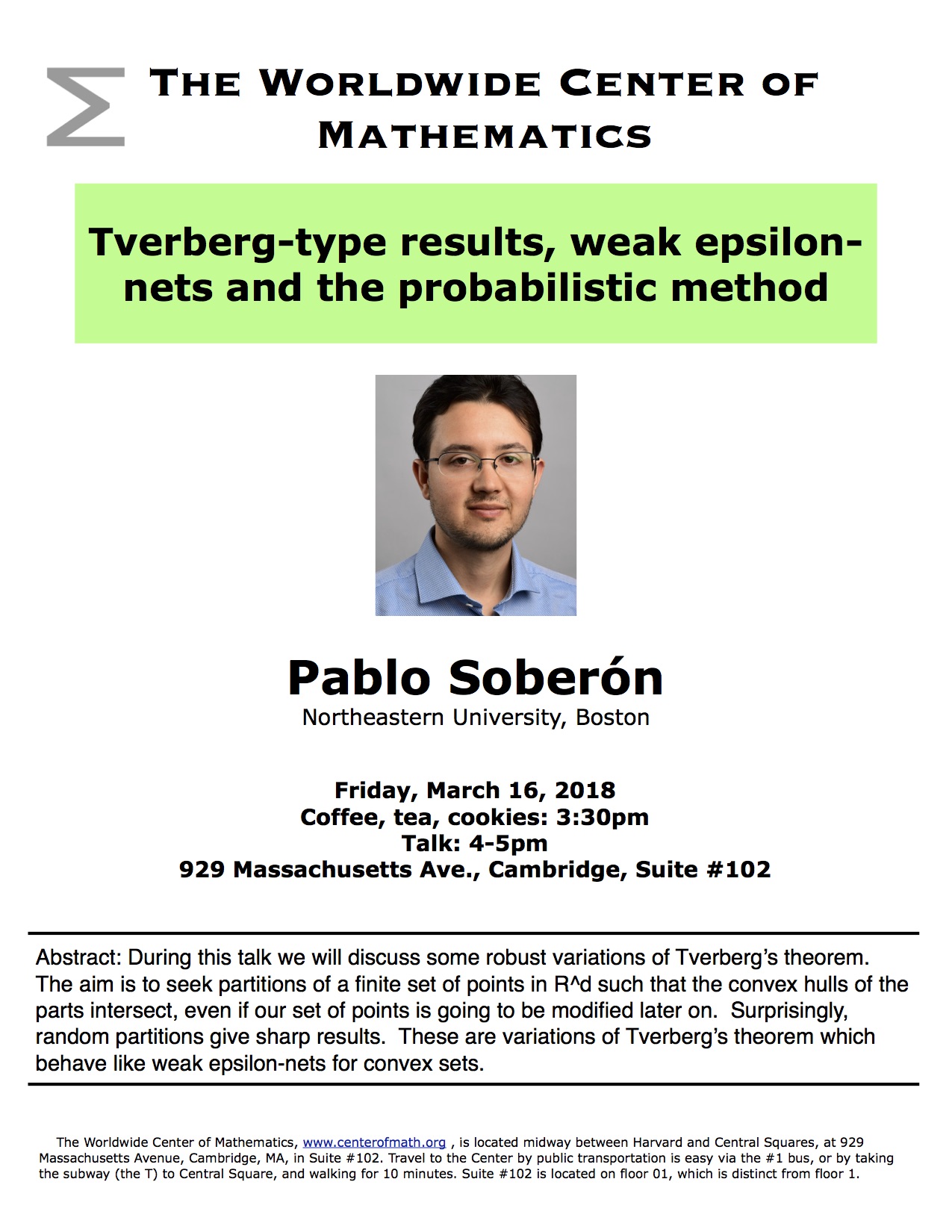
Worldwide Lecture Seminar Series: Pablo Soberón

Worldwide Lecture Seminar Series: Pablo Soberón

REGISTER

Description

The Worldwide Lecture Seminar Series Presents

Pablo Soberón - Northeastern University

Friday, March 16, 2017
Coffee, tea, cookies: 3:30pm
Talk: 4-5pm

Worldwide Center of Mathematics -- Cambridge, MA, USA
Abstract: During this talk we will discuss some robust variations of Tverberg’s theorem. The aim is to seek partitions of a finite set of points in R^d such that the convex hulls of the parts intersect, even if our set of points is going to be modified later on. Surprisingly, random partitions give sharp results. These are variations of Tverberg’s theorem which behave like weak epsilon-nets for convex sets.
Soberon @ the Center of Math


Friday, June 23, 2017

#MathChops Episode 2: Proof That the Irrationals Are a Dense Set Within the Reals


The first conception of this episode was to prove that the rationals are a dense within the reals, which is an algebraic proof showing that between any two real numbers, there is a rational number. This proof does not define the real numbers, and treats them as some empirical fact that you know; yet, once the real numbers are constructed, the proof is really trivial. The proof used in this episode utilizes an analytic definition of dense sets: if a set `A’ along with its limit points equals the `B’, then `A’ is a dense set within `B’. You will see that we construct the reals in such a way that the rationals are dense within the reals. But first, a little background.


First, we construct the natural numbers using Peano’s Axioms, and the integers can be constructed many different ways from the natural numbers (think including additive inverses). From the integers, the rational numbers are all ratios of two integers. These ratios can be thought of as finite decimal expansions, and we will construct the real numbers using Dedekind cuts. To define a real number, we chop the number line at the end of an infinite decimal expansion, and call the set of all rational numbers less than that cut the real number. Now of course, this is defining any real number as the limit point of a rational sequence, making the closure of the rationals (the rationals along with their limit points) the reals. The proof that the irrationals are a dense set within the reals is less obvious.

Construction of the rationals, from AMS.
We need to find an irrational sequence that converges to a rational number (let’s choose 1,  and get any rational number by multiplying our sequence). After some thought, the sequence
a_n = 1 + \frac{\sqrt{2}}{n} is a sequence of irrational terms whose limit point is a rational number. Thus, the irrationals are a dense set within the reals.

Proof


Tuesday, April 4, 2017

WCoM Donates Statistics Textbooks

The Worldwide Center of Mathematics recently had some winter weather make its way into a stock room and slightly damage a number of Introduction to Statistics: Think & Do (Stevens).

The damaged books will not be sold and instead will be donated.

The recipient(s) include: Siem Reap at Life and Hope Association and Phnom Penh at People Improvement Organization. Both organizations are in Cambodia.

Water-damaged books prepared for donation.

Wednesday, February 8, 2017

The Career Mathematician, Vol. 1 — Dr. Walter Sun

So you love mathematics. What next? The Career Mathematician highlights interesting and relevant work and insights offered by professional mathematicians, statisticians, logicians and more.

The Career Mathematician, Vol. 1 -- Dr. Walter Sun

Ever wonder how predictive technology works? Click here to learn how the Principal Applied Science Manager and Bing Predicts Team Lead, Dr. Walter Sun, leverages technology and some careful calculations to improve Microsoft's "Bing Predicts" feature.

Not sure this is the career for you? Click the image below for some inspiration.

Monday, September 12, 2016

Conway's Game of Life

This isn't about the board game with the spinner but rather something we consider to be much cooler! Devised in 1970, John Conway's Game of Life is an example of a cellular automaton, a discrete dynamical mathematical system. Despite its simple definition, it gives rise to patterns and objects that have very complex, even computer-like behavior. Keep reading to learn more about how the Game of Life works and what's been discovered about it! You can also dive right in with this free online resource here!

A large pattern in the Game of Life, known as a 'breeder,' the first discovered to exhibit quadratic growth. Colors for emphasis. Source.


Friday, June 17, 2016

Some of Infinity

The Center of Math is proud to announce the publication of our first non-academic text– David Craft's Some of Infinity: Peaks in the Landscape of Mathematics!


"But with mathematics, the more we explore, the bigger the world gets, and thus, for those adventurers out there who always want more, welcome to the world of math."

-David Craft, Some of Infinity


Craft's Some of Infinity: Peaks in the Landscape of Mathematics sheds an entertaining light on mathematics, resulting in a perfect read for anyone with an interest in the subject. Some of Infinity examines the roots of mathematics, as each chapter in the novel is dedicated to a different mathematical concept. Craft delivers this wide array of information in a personable and simplistic way that is accessible to all types of readers. This allows his audience to grasp and appreciate the many layers of the book. Shying away from the academic writing style of most math books, Craft aims to show the scope of mathematics and the exploration that is possible. His passion for the subject is contagious and readers will undoubtedly adopt the endless possibilities of mathematics that Craft presents.

Topics covered in Some of Infinity: Peaks in the Landscape of Mathematics
Numbers
Infinity
Probability
Fractals
Geometry
& and many more!


A modern day Renaissance man, David Craft is well versed in many areas. He received his Bachelor's degree in Mechanical Engineering from Brown, and went on to earn his Doctorate in Operations Research from MIT in 2004. Craft currently works for Harvard Medical School in oncology research, developing an algorithm for radiation planning. His many interests include Gallery 263, foraging, and creating music. 


For more about Craft's mathematical interests and career, we turn to a 2015 interview conducted by the Center of Math: 

So we’ve done a little research on your background, and you have a lot of interests, I can tell. What did you start with? What did you study at school?
     At undergraduate I studied mechanical engineering, and I studied… well, I usually say I studied applied math at MIT, but really it was a subject called Operations Research. It’s Applied Math for real world operations.

What do you do now? You are an assistant professor at Harvard Medical?
     Right, but it’s a pure research job. I have a nice position where it’s research, and I get to work on whatever I want in the field of radiation therapy for cancer treatment. So the basic idea is this: when you have a tumor that you have to hit with radiation, it’s like a puzzle- how to bring the radiation beams in. We try to conform to the target and try to avoid everything else. That’s the balance, it’s sort of a high dimensional tradeoff because there’s the tumor, but all these different organs around it like the heart, or the liver, or whatever is nearby, and you have to play a sort of balancing game amongst all those things so that’s where the  math comes in.

So after all of these hobbies, jobs, and working in Oncology, what is bringing you back to pure mathematics?
     Well, every couple of years I’ve come back to just reading a book on math; popular or in-depth books, but not quite textbooks. I’ve always quite enjoyed that, it reminds me of my school days and I like that. So the reason that I wrote this particular book is that I would be talking to friends and describe some little piece of mathematics. For example, that the number of primes is infinite. Just little topics. And I really enjoyed saying that to people, and then getting them to understand what it would mean to prove such a statement, and then getting them to understand the proof. The fact that you can do that all within like 20 minutes, even for people who wouldn’t consider themselves good at math, is just great.

     I never became a math professor because I really like the one-on-one. I have been a math professor [at Williams college] for a year, and it was good, but I like the on-on-one. I’ve had a lot of those one-on-ones with people at bars or parties, and I decided at some point that I could probably cobble these little vignettes into a book.


The book Craft speaks of became a reality titled, 
Some of Infinity: Peaks in the Landscape of Mathematics

Monday, January 11, 2016

Math in a Minute

Hello everyone, Jacob here! If you've been following the Center's videos for the past few months, you might have noticed that I like to say a whole lot of things about any given topic, and that makes my videos go on pretty long. So, with me on the way out and the next math co-op coming in soon,  I decided to challenge myself to do the opposite: in this new mini-series, you'll see me tackle some classic but nontrivial problems from all different branches of mathematics, each in a single video whose duration is sixty seconds or less. Keep reading to watch Math in a Minute!


Friday, January 8, 2016

Mathematics on Tumblr

Did you know the Center of Math is on Tumblr? On Tumblr, we get to see the more creative and funny side of math but we also get to see math education as well. That’s why we decided to name some of our favorite Tumblrs about math so that you can join in on all the fun. Keep reading to see the list…