DO the math, DON'T overpay. We make high quality, low-cost math resources a reality.

Friday, July 14, 2017

Episode 5: Königsberg Bridge Problem (Seven Bridges) [#MathChops]

The advent of graph theory, from the mind of Leonhard Euler, came from a long-standing problem for the people of Königsberg. The problem was that no couple had a long and happy marriage, if they were married in Königsberg. As tradition dictated, a newlywed couple had one chance to travel across Königsberg’s four land masses using each of the seven bridges once and only once. If the two lovers could complete this seemingly simple task, their marriage would be long and happy. Years went by and nobody could complete to task, until Euler constructed a mathematical object that broke the curse of Königsberg… a graph!


Watch the proof proposed by Euler below to learn how mathematical abstraction created a whole new field of math, which is now regarded as an important predecessor to topology. Euler’s invention itself is remarkable, but the implications to mathematical philosophy reveals something very deep in the heart of mathematics. Namely, the art of abstraction to gain a better understanding of certain truths inherent in life’s situations.

The Königsberg Bridge Problem, and its solving:

Thursday, July 13, 2017

Tuesday, July 11, 2017

Problem of the Week: 7-11-17 [Calculus I]

Be sure to let us know how you solved it in the comments below or on social media!

Solution below.

Thursday, July 6, 2017

Episode 4: Uncountability of Real Numbers [#MathChops]


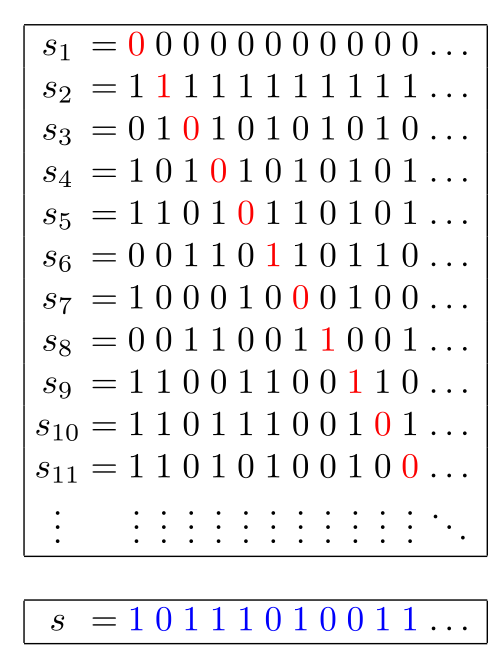
This week’s Top Pop Math Chop comes from Georg Cantor, who first solved this piece of set theory in 1891. He presented this as a mathematical proof which showed it was impossible to link infinite sets with an infinite set of the natural numbers. This is known today as Cantor’s diagonal argument, which he proved using binary numbers.


Cantor showed that if he has a list of binary numbers, takes one digit from each going diagonally, produces a new number, and swaps every single digit with a corresponding 1 or 0 (if is a 1 it becomes 0 and vice versa), that the number will be different than every other binary number listed before it. This is because in the first number the first digit is different, so it’s definitely different than the new number; in the second number the second digit is different than the second digit in the new number and so on.


You can do this same thing with real numbers, and produce infinite decimals between 0 and 1. This shows the real numbers are uncountable.


Check out the video below explaining Georg Cantor’s proof:

Advanced Knowledge Problem of the Week: 7-6-17 [calculus]

Be sure to let us know how you did in the comments below or on social media!

This week's problem comes from our textbook, Worldwide Multivariable Calculus, so feel free to check it out or any other affordable texts we offer. Enjoy this problem and try to find its relation to July 4th!

Solution below.

Friday, June 30, 2017

Problem of the Week: 7-4-17 [Geometry]

Be sure to let us know how you did in the comments below or on social media!

Solution below.